The Stress-Fat Loop: Why High-Performers Store
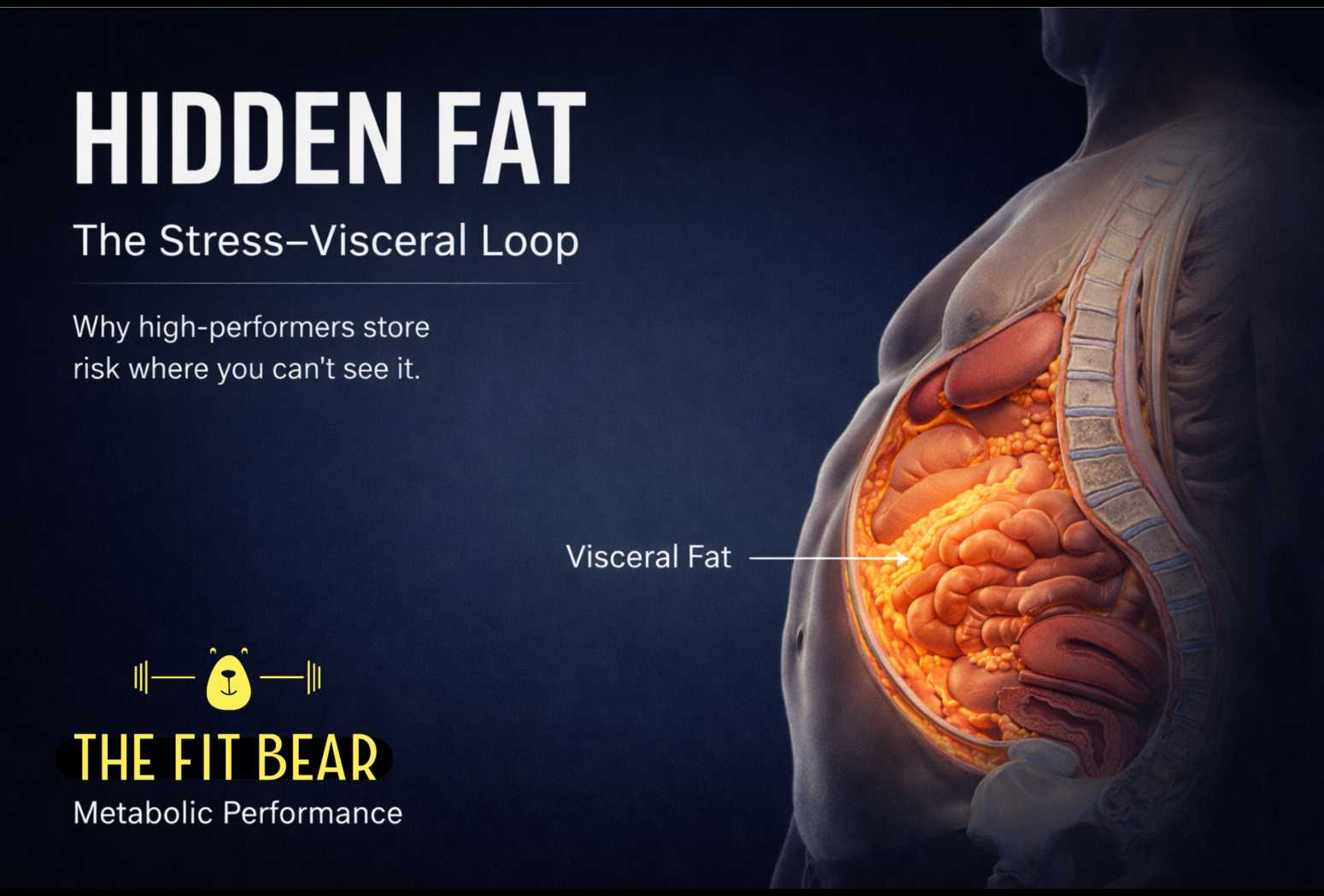
If you look in the mirror and see a bit of a "spare tire," you might be thinking about aesthetics. But as the founder of The Fit Bear, I’m here to tell you that the fat you can’t see - the fat packed deep inside your abdomen - is far more dangerous than the fat you can pinch. In the fitness industry, we often obsess over subcutaneous fat (the stuff right under the skin). But if we want to talk about longevity, hormonal health, and genuine performance, we need to talk about visceral fat.
It’s Not Just Storage, It’s an Organ
For a long time, we viewed fat as a passive energy warehouse. We thought of it like a backup battery for a laptop.
However, visceral fat (VAT) functions more like an active endocrine organ. Because it surrounds your vital organs -the liver, pancreas, and intestines - it has direct access to your portal vein. VAT doesn't just sit there; it pumps out inflammatory cytokines and signaling molecules that keep your body in a state of chronic low-grade inflammation.
It’s like having a small, smoldering fire inside your torso 24/7. This leads to
- Insulin Resistance: It makes blood sugar harder to control and disrupts metabolic signaling.
- Systemic Inflammation: It accelerates metabolic decline and increases long-term cardiac risk.
- Hormonal Chaos: In men, visceral fat contains high levels of the enzyme aromatase, which converts testosterone into estrogen.
The Executive Paradox
You do not need to be obese for this to happen. You can still look “fine,” train twice a week, and sit in a normal BMI range.
But executives are uniquely exposed. Chronic cognitive load, sustained responsibility, and travel disruption shift fat storage centrally. Think of your abdomen like a suitcase. Subcutaneous fat is the clothes you try to stuff in the side pockets. Visceral fat is what happens when you cram so much into the main compartment that the structure of the suitcase starts to warp. Once this fat builds, it reinforces the problem. It worsens insulin sensitivity, and higher insulin suppresses your ability to mobilize that fat. The longer this environment persists, the more entrenched the physiology becomes.
The Fit Bear Protocol: Deliberate Environmental Redesign
1. Reduce "Low-Grade" Activation
You are not trying to avoid stress; you are trying to avoid constant activation. Reduce daily decision fatigue. Automate your meals or use a service. Create protected deep work blocks with no notifications.
2. Stabilize Sleep Structure
Visceral fat accumulation correlates strongly with chronic sleep restriction. Protect 7 to 8 hours in bed as a standard. Avoid alcohol as a "sleep solution" - it only fragments your recovery and spikes nighttime cortisol.
3. Increase Skeletal Muscle Mass
Muscle is your primary blood sugar disposal site. Lift 3 to 4 times per week focusing on compound movements. Aim for protein intake at 1.6 to 1.8 grams per kilogram of bodyweight. More muscle reduces the insulin demand of each meal.
4. Build Aerobic Capacity
Resistance training alone isn't enough. Add 2 to 3 Zone 2 sessions weekly. This improves mitochondrial density and fat oxidation. This is about improving your fuel-handling capacity, not just burning calories.
5. Track Distribution, Not Just Weight
Bodyweight alone is insufficient. Measure your waist circumference relative to your height monthly. Monitor trends in your labs - triglycerides, HDL, and fasting glucose - to see how your internal "machinery" is actually running.
The Bottom Line
Don’t just lose weight to look better in a swimsuit. Lose the visceral fat so your heart, liver, and brain can actually do their jobs. At The Fit Bear, we don’t just build "show muscle"; we build metabolic resilience.
Stop feeding the fire. Start fueling the bear
Follow The Fit Bear for posts that help you live and lead longer